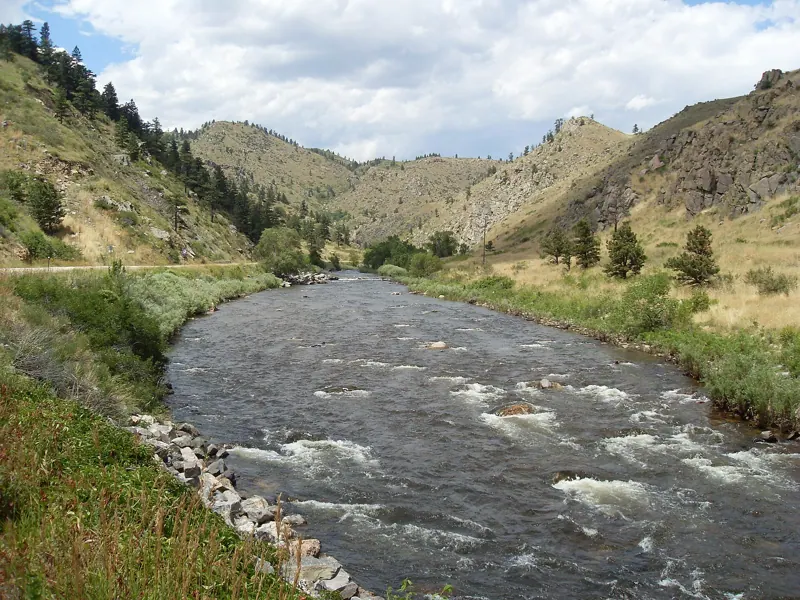
Right now
Live from Colorado DWR gauge CLAFTCCO and National Weather Service.
How to fish it
Checked Nov 27
- Best time
- 11:30 a.m. to 2:30 p.m. in the lower canyon. Gateway Natural Area is open dawn to dusk.
- Wading and ice
- Shelf ice along the banks is a trap. Don't stand on it, and get in and out where the bank is bare.
- Fly rod
- #16–18 beadhead pheasant tail with a #20–22 midge below it, under a small indicator set deep
- Fly rig
- Two-fly nymph rig under a small indicator, 5x–6x. Short drifts through the slower pools in the lower canyon, midday.
- Spinner
- A 1/16 oz jig crawled along the bottom of the deepest, slowest pools on the sunny side.
- Bait
- A small piece of worm drifted along the bottom, in the statewide-rules water only. Leave the bait in the car at Gateway. Bait is legal in the statewide-rules water of the lower canyon (the CO-14 pull-offs). At Gateway Natural Area it is flies and lures only and all trout go back
Best flow range here: about 20 to 200 cfs. The live flow above tells you where today sits.
Tie-on advice last checked on November 27, 2026. Ask at the local fly shop for what hatched this morning. They know before we do.
What's being caught
- Fish
- Mostly brown trout, plus some mountain whitefish and a limited rainbow fishery (CPW)
- Sizes
- Size not published. Lower canyon pocket water runs mostly small to medium.
Species and sizes: source, checked Nov 29.
Recent reports
- Nov 17 · Sunrise AnglersDry-dropper on the warmer days, nymphs on the cooler ones; best later in the day. Hare's Ear and Pheasant Tail #16-20, Adams #18-20.
- Water
- Freestone river through Poudre Canyon and Fort Collins; Colorado's only National Wild and Scenic River
- Drive from Denver
- About 1 hour 15 minutes to the canyon mouth via I-25 and US-287
- Access
- Pull-offs along CO-14 in the canyon, Gateway Natural Area, and city parks on the Poudre River Trail in town
- Limits
- Most of the lower canyon: statewide, 4 trout a day. Gateway reach, and Hombre Ranch to the Pingree Park bridge: flies and lures only, all trout released
- Best for
- Pocket water for browns and rainbows, an easy day from north Denver
- Season
- Year-round in the lower canyon; best late summer and fall after runoff
- Fees
- Gateway Natural Area: $8 per vehicle, card only; most highway pull-offs are free
- Dogs
- Leashed dogs are allowed at Gateway Natural Area (City of Fort Collins, checked November 20, 2026)
Before you drive
- Open now: Yes, in the lower canyon. In winter fish midday, 11:30 to 2:30. See the live gauge below.
- Parking: Gateway Natural Area, 5216 Poudre Canyon Rd: $8 per vehicle, card only, dawn to dusk. Pull-offs free.
- Fish: Mostly brown trout, plus some mountain whitefish and a limited rainbow fishery (CPW).
- Limits: Most of the lower canyon: 4 trout a day, bait OK. Gateway: flies and lures only, all released.
- Safe to eat: Check CDPHE's dashboard first. Statewide: adults up to 1 meal a week of rainbow or brown trout.
- Tie on: #16-18 beadhead pheasant tail, #20-22 midge below it, indicator set deep (checked Nov 27).
- Where to stand: Lower canyon: deepest, slowest sunny pools, 3 to 5 ft. Never stand on shelf ice.
- Crowds: CO-14 is busy with rafters and campers on summer weekends. Winter: Unknown.
- Dogs and kids: Leashed dogs at Gateway Natural Area. Restrooms at Gateway (some seasonal).
- Bring: License, a card for the Gateway pass, small nymphs. Park fully off the road on CO-14.
- Backup: Big Thompson River (see our page).
A short summary of this page. Details and sources are in the sections below.
Where to park
Gateway Natural Area
- About 15 miles from Fort Collins up CO-14 (5216 Poudre Canyon Road). Daily pass $8 per vehicle, sold onsite, card only. Open dawn to dusk.
- Restrooms (some seasonal), leashed dogs allowed. Access to the main river and the North Fork confluence.
CO-14 pull-offs, lower canyon
- Turn west onto CO-14 at the US-287 junction (Ted's Place). Pull-offs line the highway for the next several miles. Park fully off the road; it's narrow and curvy.
- Public and private land mix near the canyon mouth. Fish where it's signed public or Forest Service land.
Lee Martinez Park (in town)
- City park on the Poudre River Trail in north Fort Collins. Walk the trail to reach the river. Slower water; best in cooler months.
Lots, fees and hours change. Check posted signs when you arrive.
The short answer
The Poudre runs out of the mountains just northwest of Fort Collins, and CO-14 follows it for most of the canyon, so access is easy: pull off and fish. The lower canyon is pocket water full of browns and rainbows, mostly small to medium. In town it slows down and runs along the Poudre River Trail, with city parks and natural areas on the bank.
Where to stand this week (late November)
Stay in the lower canyon. The upper river is colder and icing up, and the short day gives you about three good hours: 11:30 to 2:30. Look for the deepest, slowest pools on the sunny side, 3 to 5 feet deep, and skip the pocket water. A #16-18 beadhead pheasant tail with a #20-22 midge below it, under a small indicator set deep, is the fly rig. On spinning gear in the statewide-rules water, drift a small piece of worm or crawl a 1/16 oz jig along the bottom. At Gateway Natural Area the river is flies and lures only and all trout go back, so leave the bait in the car there. Shelf ice along the banks is a trap: do not stand on it, and land fish where the bank is bare. The mistake to avoid: starting early. The canyon holds cold air and the fish do not move until the sun has been on the water.
Get next Thursday's Cache la Poudre River call
Every Thursday: whether Cache la Poudre River is open, its latest flow and anything that changed, plus the 3 best waters near Denver that weekend, with what to tie on. Reply with any water and we'll tell you how it's fishing.
Where to fish
- Lower canyon: the first miles of CO-14 above the US-287 junction (Ted's Place) have the most pull-offs. Gateway Natural Area, about 15 miles from town, has parking, restrooms and access where the North Fork comes in.
- Middle and upper canyon: farther up, the river gets bigger and more remote, with campgrounds and Forest Service access. Some of this water has special rules; see below.
- In town: city parks and natural areas along the Poudre River Trail, such as Lee Martinez Park. Slower, warmer water; best in cooler months.
Regulations
Most of the lower river follows statewide rules, with one exception right where many people park: at Gateway, the river is catch and release with flies and lures only. Higher in the canyon there are more special sections. The exact stretches are in the limits section at the bottom of this page. Boundaries are signed; check the CPW Fishing Atlas before you fish a new stretch.
When to go
- Fall (September to November): low, clear water and active browns. The best time on the lower river.
- Winter: fish the lower canyon midday on calm, sunny days. Deeper, slower pools hold the fish. Watch for ice on the shady stretches and the road.
- Spring: blue-winged olives and midges before runoff; the river rises fast once snowmelt starts, usually by late May.
- Summer: big runoff into early July, then good dry-dropper fishing. CO-14 is busy with rafters and campers on weekends.
Flies and rigs
Most days, a dry-dropper or a two-nymph rig covers it: a beadhead pheasant tail or hare's ear #16-20 under a small indicator, plus a small Adams or parachute dry when fish rise. In winter, go smaller with midges and fish slow water. Short, accurate drifts behind every boulder beat long casts here.
Limits and tackle rules
- Most of the lower canyon and the river in Fort Collins: no special rule, so the statewide limit applies. 4 trout a day, 8 in possession, and bait, lures and flies are all legal.
- From the upper boundary of Gateway Park (the Fort Collins water diversion) down to the North Fork: flies and lures only, all trout released. That is the river at Gateway Natural Area.
- North Fork, from Milton Seaman Reservoir down to the main river: flies and lures only, all trout released.
- From the west boundary of Hombre Ranch (below Rustic) down to the Pingree Park Road bridge: flies and lures only, all trout released.
- From the upper boundary of Big Bend campground down to Black Hollow Creek: flies and lures only, all trout released.
- From the Rocky Mountain National Park boundary down to Joe Wright Creek: flies and lures only, 2 trout.
- Source: CPW 2026 Colorado Fishing brochure (special regulations), checked November 20, 2026.
Keeping and eating fish
Colorado's health department (CDPHE) sets statewide limits on how often to eat fish you catch. They apply to any water that does not have its own stricter advisory. A meal is 8 ounces of fish, about the size of your palm. Mercury is the main concern statewide; it builds up in older fish and in fish that eat other fish, and no way of cleaning or cooking takes it out.
- Adults: up to 2 meals a week of brook trout or kokanee.
- Adults: up to 1 meal a week of rainbow, brown or lake trout, crappie, bluegill and other sunfish, yellow perch, catfish, wiper, white bass, saugeye, carp, walleye under 15 inches, largemouth bass under 15 inches or northern pike under 34 inches.
- Adults: up to 2 meals a month of walleye over 15 inches, smallmouth bass under 15 inches, cutthroat trout or northern pike over 34 inches.
- Adults: no more than 1 meal a month of largemouth or smallmouth bass over 15 inches, or tiger muskie.
- Pregnant, or might become pregnant: up to 1 meal a week of rainbow, brown or brook trout, kokanee or bluegill. Up to 2 meals a month of crappie, yellow perch, catfish, wiper, white bass, saugeye, carp, lake trout, cutthroat, northern pike, walleye under 15 inches or bass under 15 inches. No more than 1 meal a month of walleye over 15 inches, bass over 15 inches or tiger muskie.
- Children 6 and under: up to 2 meals a month of rainbow, brown, brook or cutthroat trout, kokanee, bluegill, catfish, white crappie, white bass or saugeye. No more than 1 meal a month of walleye, bass, northern pike, yellow perch, black crappie, wiper, carp or lake trout.
Some waters have their own stricter advisory for mercury or PFOS. CDPHE lists them water by water on its fish consumption dashboard, so look this water up there before you keep fish, and check the bag limit for this water in the current CPW regulations. Source: CDPHE, checked November 20, 2026.
Want a guide?
Tell us your dates. We'll pass your request to a local shop that guides this water, and the shop replies to you directly if it can help.
Find me a guide
Questions anglers ask
- Can you fish the Poudre in winter?
- Yes, in the lower canyon. Fish midday in the slower, deeper pools with small nymphs and midges.
- Is there a fee to fish Gateway Natural Area?
- Yes. A daily pass is $8 per vehicle, sold onsite by card only. It's open dawn to dusk.
- Is the Poudre catch and release?
- Only in certain stretches. Most of the lower river follows statewide rules. The river at Gateway (upper park boundary down to the North Fork), the stretch from the west boundary of Hombre Ranch down to the Pingree Park Road bridge, and Big Bend campground down to Black Hollow Creek are flies and lures only, catch and release.
- How far is Poudre Canyon from Denver?
- About an hour and 15 minutes to the canyon mouth.
- Can you use bait on the Poudre River?
- On most of the lower canyon and in Fort Collins, yes: statewide rules apply and the limit is 4 trout a day. Not at Gateway (upper park boundary down to the North Fork) or on the other special sections upstream, which are flies and lures only.
Make a trip of it
We planned the whole day for you: where to fish first, where to park, fly shops, food after and a backup plan.
Find today's best water near Denver
Read next
Fly Fishing the Big Thompson River
Fly fishing the Big Thompson below Olympus Dam near Estes Park: pocket water, lots of fish, the right flow gauge, flies and low-water tactics.
5 min readPhoto: Wusel007, CC BY-SA 3.0
Fishing St. Vrain Creek in Lyons
Fly fishing St. Vrain Creek in Lyons: catch-and-release, flies-and-lures-only rules in town, public access, flows and the best flies by season.
3 min read
Winter Fly Fishing Near Denver
A practical guide to winter fly fishing near Denver: which tailwaters stay open, the best time of day, midge rigs, safety and staying warm.
3 min read