Right now
Live from National Weather Service.
How to fish it
Checked Nov 15
- Fly rod
- Small jig, balanced leech, Clouser for warmwater fish
- Fly rig
- Slow retrieve near structure. Check the state park's seasonal closures first.
- Spinner
- 1/16–1/8 oz inline spinner (Mepps, Panther Martin) or a small jig. Cast across, retrieve slow, and slower still when it's cold.
Tie-on advice last checked on November 15, 2026. Ask at the local fly shop for what hatched this morning. They know before we do.
What's being caught
- Fish
- Channel catfish, bass and other warmwater fish
- Sizes
- Size not published.
Species and sizes: Seamline's notes, checked Nov 22.
No shop or agency report from the last 21 days. Call a local shop before you drive.
- Water
- 1,950-acre prairie reservoir near Brighton
- Drive from Denver
- About 20 minutes northeast via I-76
- Status now
- Low water. All boating, hand-launched craft included, has been closed since August 3, 2026 for the rest of the season. The park page also shows a red alert for toxic algae: stay out of the water and keep dogs out (checked November 20, 2026)
- Access
- Shore fishing on the north half only
- Hours
- Park open 5 a.m. to 10 p.m.
- Best for
- Warmwater fishing close to north Denver; ADA piers
- Fees
- State parks daily vehicle pass: $10-$12 with Colorado plates, $15-$17 out of state (CPW park page, read November 29, 2026), or an annual pass
- Dogs
- Leashed dogs allowed, but not in the wildlife refuge
- Limits
- Walleye and saugeye: 15 inch minimum, only one over 21 inches a day. Other species statewide
Before you drive
- Open now: Shore only, north half; 5 a.m. to 10 p.m. Check CPW's park page for algae alerts; avoid the water.
- Parking: Main entrance, 13401 Picadilly Rd, Brighton. State parks pass: $10-$12 a day CO plates, $15-$17 out of state.
- Fish: Warmwater species: catfish and bass; limits listed for walleye, saugeye, crappie. Sizes: Unknown.
- Limits: Walleye and saugeye 15 in minimum, one over 21 in a day. Other species statewide.
- Safe to eat: PFOS advisory (CDPHE, May 2025) for certain species. Read CDPHE's Barr Lake entry before eating any.
- Tie on: Small jig, balanced leech, Clouser for warmwater fish (checked Nov 15).
- Where to stand: North-side shore, on firm ground. Stay off mud and early ice: nobody checks the ice here.
- Crowds: Unknown.
- Dogs and kids: Leashed dogs, not in the refuge. Keep dogs and kids out of the water (algae). ADA piers.
- Bring: State parks pass, license, nightcrawlers, hand wipes. Wash up after handling fish or wet line.
- Backup: Aurora Reservoir (stocked trout close to shore) or Standley Lake: see our pages.
A short summary of this page. Details and sources are in the sections below.
Where to park
Barr Lake State Park main entrance
- From I-76, exit 22 (Bromley Lane), east to Picadilly Rd, then south about a mile and a half to the entrance on the west side.
- State parks pass required. Use the north-side lots for fishing; the south half is refuge.
Lots, fees and hours change. Check posted signs when you arrive.
The short answer
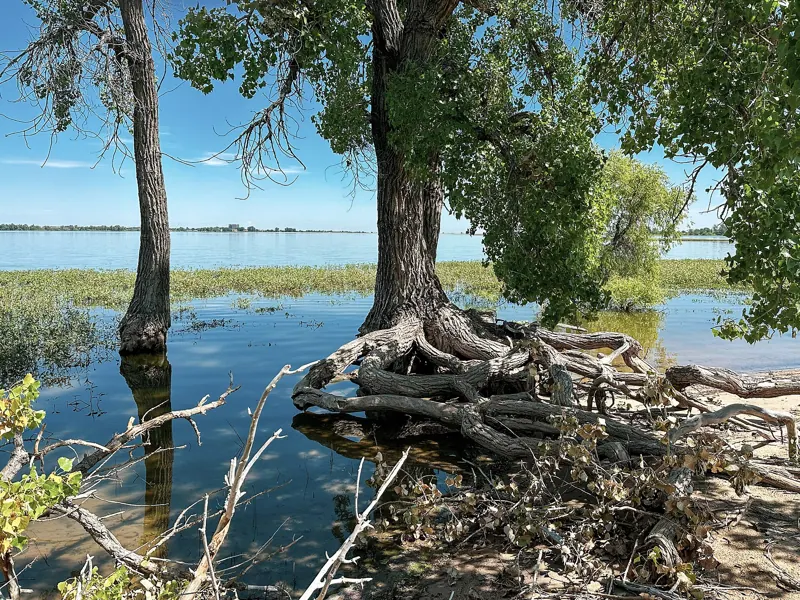
Barr Lake is a big, open reservoir 20 minutes from north Denver, better known for birds than fish, but it fishes well for warmwater species. The south half is a wildlife refuge, so plan around the north side.
Where to stand this week (late November)
This is not the week for Barr Lake, and we would rather say so. The lake is low, boating has been closed since August, and the park page still had it on red alert for toxic algae when we re-read it on November 29, 2026, with advice to avoid contact with the water. Warmwater fish have also slowed far down in the cold. If you go anyway, fish from the north-side shore, expect the water's edge to be well out from the usual bank spots, stay on firm ground, keep dogs and kids out of the water, and wash up after handling fish or wet line. For bait, a nightcrawler on the bottom is the rig to soak; on a fly or spinning rod, work the small jig or balanced leech from How to fish it slowly near the bottom. The better plan this week is Aurora Reservoir, where stocked trout are close to shore, or Standley Lake for a short bank session. The mistake to avoid: walking out onto mud or early ice at the water's edge. Low lakes leave soft bottom, and nobody checks the ice here. Questions about ice: the Barr Lake State Park office at 303-659-6005 (checked November 28, 2026); the park does not report ice.
Get next Thursday's Barr Lake State Park call
Every Thursday: whether Barr Lake State Park is open, what the managing agency says about the ice, and any closure or rule change, plus the weekend's top 3 near Denver. One email a week.
The rules that matter
- No fishing in the wildlife refuge (south half) or in the irrigation canals around the lake.
- Fish from shore on the north side. CPW closed all boating, including hand-launched craft, for the rest of 2026 because of low water; when boating reopens it is limited to the north half.
- No swimming or wading.
- Dogs on leash, and not in the refuge.
- Toxic algae: on November 20, 2026 the park page had the reservoir on red alert for high concentrations of toxic algae, which can harm people and pets. Avoid contact with the water, keep dogs away from it, and wash your hands after handling fish or wet gear.
How to fish it
Worms or cut bait on the bottom for catfish, and soft plastics or crankbaits along the shoreline for bass. The accessible piers are an easy start.
Limits and tackle rules
Walleye and saugeye must be at least 15 inches, and only one over 21 inches can be kept per day. CPW lists nothing else special for Barr Lake, so the statewide limits apply to everything else: 5 walleye and saugeye combined, 5 bass, 10 catfish, 20 crappie. Read the eating section below before you keep anything; this lake has its own PFOS advisory and, when we re-read the park page on November 29, 2026, a toxic algae red alert. Source: CPW 2026 Colorado Fishing brochure (special regulations), checked November 20, 2026.
Keeping and eating fish
Barr Lake has its own state advisory. In May 2025 Colorado's health department (CDPHE) added a site-specific fish consumption advisory here for PFOS, a long-lasting human-made chemical, covering certain fish species. Chatfield Reservoir, Barr Lake and Runyon Lake have PFOS advisories, and CDPHE lists other waters with mercury or PFOS advisories on its fish consumption dashboard. According to CDPHE, PFOS in fish depends mostly on how close the water is to a contamination source, and cleaning or cooking the fish does not remove it.
The species named and the meals-per-month limit for each are on CDPHE's fish consumption dashboard under Barr Lake. Read that entry before you eat anything from here, and use its numbers, not the statewide ones, for the species it names. For species it does not name, start from the statewide limits below. Source: CDPHE, checked November 20, 2026.
Colorado's health department (CDPHE) sets statewide limits on how often to eat fish you catch. They apply to any water that does not have its own stricter advisory. A meal is 8 ounces of fish, about the size of your palm. Mercury is the main concern statewide; it builds up in older fish and in fish that eat other fish, and no way of cleaning or cooking takes it out.
- Adults: up to 2 meals a week of brook trout or kokanee.
- Adults: up to 1 meal a week of rainbow, brown or lake trout, crappie, bluegill and other sunfish, yellow perch, catfish, wiper, white bass, saugeye, carp, walleye under 15 inches, largemouth bass under 15 inches or northern pike under 34 inches.
- Adults: up to 2 meals a month of walleye over 15 inches, smallmouth bass under 15 inches, cutthroat trout or northern pike over 34 inches.
- Adults: no more than 1 meal a month of largemouth or smallmouth bass over 15 inches, or tiger muskie.
- Pregnant, or might become pregnant: up to 1 meal a week of rainbow, brown or brook trout, kokanee or bluegill. Up to 2 meals a month of crappie, yellow perch, catfish, wiper, white bass, saugeye, carp, lake trout, cutthroat, northern pike, walleye under 15 inches or bass under 15 inches. No more than 1 meal a month of walleye over 15 inches, bass over 15 inches or tiger muskie.
- Children 6 and under: up to 2 meals a month of rainbow, brown, brook or cutthroat trout, kokanee, bluegill, catfish, white crappie, white bass or saugeye. No more than 1 meal a month of walleye, bass, northern pike, yellow perch, black crappie, wiper, carp or lake trout.
Questions anglers ask
- Where can you fish at Barr Lake?
- From shore on the north half (boating is closed for the rest of 2026 because of low water). The south half is a wildlife refuge and closed to fishing. The park page showed a red alert for toxic algae on November 20, 2026, so avoid contact with the water and check that page before you go. On weekdays, part of the Lake Loop trail (south Niedrach entrance to Mile Marker 2) is closed for dam work.
- How much does Barr Lake cost?
- A state parks daily vehicle pass: $10-$12 with Colorado plates, $15-$17 with out-of-state plates (CPW park page, read November 29, 2026), or an annual pass. Walking or biking in is $4.
- What is the walleye limit at Barr Lake?
- Walleye and saugeye must be at least 15 inches, only one over 21 inches can be kept per day, and the statewide bag is 5 combined. Read the PFOS advisory and the algae alert before you keep fish.
- Is it safe to eat fish from Barr Lake?
- Only in limited amounts. Colorado's health department (CDPHE) added a site-specific fish consumption advisory for Barr Lake in May 2025 because of PFOS in certain fish species. The species and the meals-per-month limit for each are on CDPHE's fish consumption dashboard; read the Barr Lake entry before you eat fish from here. Cooking or cleaning does not remove PFOS. Source: CDPHE, checked November 20, 2026.
Find today's best water near Denver
Read next
Fishing Valente Lake (Adams County, near Thornton)
Fishing Valente Lake in Adams County near Thornton: three ponds, docks, the South Platte Trail, cold-water panfish and bass rigs, and dog-friendly access.
6 min read
Fishing the West Gravel Lakes (Thornton)
Fishing Thornton's West Gravel Lakes along the South Platte: what lives there, gate locations, seasonal hours, and how to fish pressured city water.
4 min read
Fishing Near Thornton, Colorado
Where you can legally fish near Thornton and north Denver: city lakes, Adams County parks, the gravel lakes, and which waters are private (including Smith Reservoir on Heritage Dr).
5 min read
Fishing the Rocky Mountain Arsenal: Lake Ladora and Lake Mary
Fishing the Rocky Mountain Arsenal National Wildlife Refuge in Commerce City: catch-and-release at Lake Ladora and Lake Mary, the $3 daily fee, barbless hooks, no live bait, where to pay, and the April to November 30 season.
7 min readPhoto: USFWS Mountain-Prairie, Public domain
Fishing in Commerce City, Colorado
Where you can legally fish in and around Commerce City, Colorado: Lake Ladora and Lake Mary at the Rocky Mountain Arsenal (season ends November 30), Barr Lake next door, the Adams County ponds along the South Platte, and the city code that bans fishing in city parks unless posted, with fees, bait rules, hours, dogs and ice.
10 min readFishing Piers Near Denver
Every fishing pier, dock and ADA-accessible fishing platform we could confirm on agency pages near Denver: Aurora Reservoir, Bear Creek Lake Park, Barr Lake, Standley and Ketner lakes, Evergreen Lake and more, with locations, fees, bait rules and what is open in late November.
16 min readWalleye Fishing Near Denver
Where to catch walleye and saugeye near Denver: 11 public reservoirs where the agency that runs them lists walleye or saugeye, each lake's walleye rule from the current state regulations or the managing agency, daily fees, hours, each agency's own ice rule, and how to fish for walleye from shore in cold weather.
18 min read
When Do Denver-Area Lakes Open for Fishing in 2027?
When Denver-area lakes open for fishing in 2027: the season each managing agency states for Quincy Reservoir, Thornton's Gravel Lakes, the Rocky Mountain Arsenal, Spinney Mountain and more, plus boating seasons, license dates and what stays open all winter.
19 min readPhoto: Seamline